
95% Boring
Retirement investing is all about discipline.
Pick a strategy that’s optimized for maximum returns and lowest cost, then deploy it, and let time compound your wealth.
Many DIY investors choose a passive, low-cost index investing strategy — using mutual funds or ETFs from Fidelity, Vanguard, iShares, and Schwab, and allocating funds to stocks and bonds based on age and risk tolerance.
For example, a 65-year-old recent retiree with a moderate risk tolerance might allocate her IRA portfolio to invest 65% stocks and 35% bonds and cash (calculate your asset allocation).
It could look like this:
- 50% Total U.S. Stock Market (VTI or VOO)
- 15% Total International Stock Market (VXUS)
- 30% Total Bond Market (BND)
- 5% Money Market Fund/ST Bonds/Cash
With just a handful of investments, she can expect to achieve solid returns and avoid paying an advisor to do something more complicated and expensive.
From this baseline “three fund” portfolio, the potential for tweaks is infinite.
You could add small-cap value, dividend ETFs, inflation-adjusted bonds (TIPS), tech-focused index funds, or municipal bond funds (taxable account), for example.
But generally speaking, the more you veer away from an “optimized” portfolio, the greater the chances of underperforming your portfolio’s full potential.
That’s because most professional fund managers struggle to beat their benchmarks over multi-year periods, after fees.
You probably will too.
So as DIY investors, we aim for the benchmark and balance stock returns against lower risk/volatility assets, according to age and risk tolerance.
Own the S&P 500, get S&P 500 returns (minus negligible fees).
This portfolio is simple, diversified, suitable for most DIY investors… and boring.
In the context of investing, boring has a very positive connotation.
Whereas sophistication and complexity can lead to more volatility risk, tax complications, and higher fees.
Many DIY investors are perfectly content with boring. They have the fortitude to set and forget their portfolio until the day they need a portion of it for living expenses.
However, some of us are not entirely content with a simple and boring investment strategy.
Hobbyists, news watchers, tech enthusiasts, and risk-takers struggle to sit idle while the ebbs and flows of the market intrigue.
They are further encouraged by social media, newsletter sellers, and TV personalities to “beat the market”, even though the odds are stacked against them.
Speculative investing beyond “the boring” comes with more research, higher risk of loss, and a good chance of underperformance.
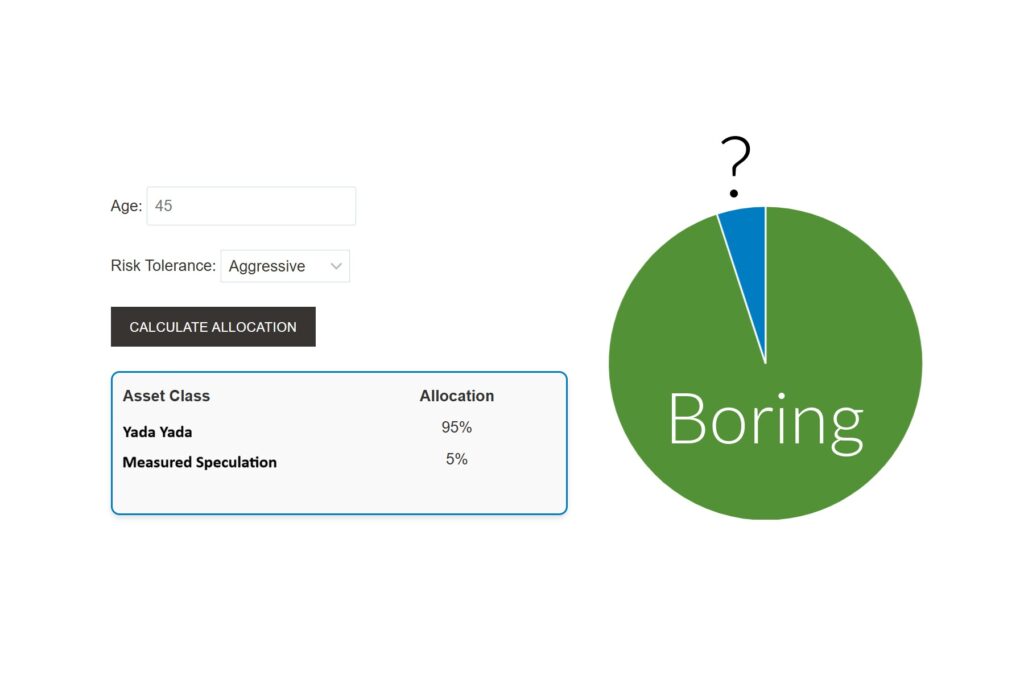
But for those who can’t sit idle while watching the markets and world around us without taking some risk, I advocate for measured speculation with a portion of your wealth.
That is, using 5% of your invested assets to invest in opportunities where your expertise, professional background, independent research, and gut feelings lead you.
I know that’s contrary to a lot of “sound financial advice” out there.
But a few reasons have led me to say it’s OK to experiment with higher-risk/reward investments for those compelled.
First, no self-made ultra-wealthy person became that way because they played it safe.
Risk-taking is part of our culture and DNA, even though so many of us are comfortable playing it safe.
At some point, the ultra-wealthy bet big on themselves or investments.
I know some extremely successful and wealthy people who continually make large investments into risky assets.
That’s how they got rich in the first place, and they don’t just stop once “way richer than you and me” status is attained.
And while that may sound unhealthy, the endless pursuit of more wealth is very fulfilling for some people, and it drives much of the U.S. economy and jobs market.
Measured risk-taking is good.
Second, your life experiences and curiosities may give you a one-up on the markets.
I’m not talking about your ability to learn stock tips from an online influencer, but genuine knowledge that can be converted into an investment.
Don’t fight your research or specialized knowledge because it’s not the conventional retirement investing wisdom.
That said, don’t bet the farm.
If you’re going to invest in something other than index funds, invest small with just 5% of your invested assets.
If you achieve success, the returns could make a meaningful contribution to your overall wealth.
But if your investments lag, you didn’t break your portfolio.
Moreover, failure feeds that speculative itch while making you think harder on the next attempt (or avoiding it altogether).
All the while, you acted on your ambitions, curiosities, research, and gut feelings to potentially multiply your capital — and minimize regret.
For some, finance is a constant stress.
For others, including me, finance and investing are interesting topics and a big part of our lives.
By putting 95% of your assets into “the correct” places, you can be comfortable freeing up 5% of your assets for speculation.
Ease up on the rigid retirement discipline just a little bit.
My area of research and expertise is in IPOs and venture capital — it’s the topic of my other website and podcast, and I’m deeply interested in new technologies and the startup ecosystem.
Venture capital happens to be a place where large returns (2X-20X or more) are possible.
It’s where the ultra-wealthy often invest their money to increase total returns or invest in technologies for personal and societal gain.
I invest in IPOs and venture capital with only a small portion of my wealth (less than 1%), and speculate a bit with a handful of growth stocks as well.
But the bulk of my invested wealth is in Fidelity total market index funds like FSKAX, FSNAX, and FSGGX.
That gives me a foundation of market-matching returns from which I can build upon with measured speculation.
Many of you have no interest in anything more complicated than a three-fund portfolio.
Boring is just fine. Don’t put more money at risk if you don’t want to.

Craig is a former IT professional who left his 19-year career to be a full-time finance writer. A DIY investor since 1995, he started Retire Before Dad in 2013 as a creative outlet to share his investment portfolios. Craig studied Finance at Michigan State University and lives in Northern Virginia with his wife and three children. Read more.
Favorite tools and investment services (Sponsored):
Boldin — Spreadsheets are insufficient. Build financial confidence. (review)
ProjectionLab — Build financial plans you love. (review)
Empower — Free net worth and portfolio tracking + retirement planning. User since 2015.
Sure Dividend — Research dividend stocks with free downloads (review):
- Dividend Kings — 50+ stocks that have increased dividends for 50+ years.
- Monthly Dividend Stocks — List of 70+ stocks that pay a dividend every month.
- Dividend Champions — 140+ stocks that have increased dividends for 25+ years.