
Travel Scams and Robbery on the Backpacker Trail
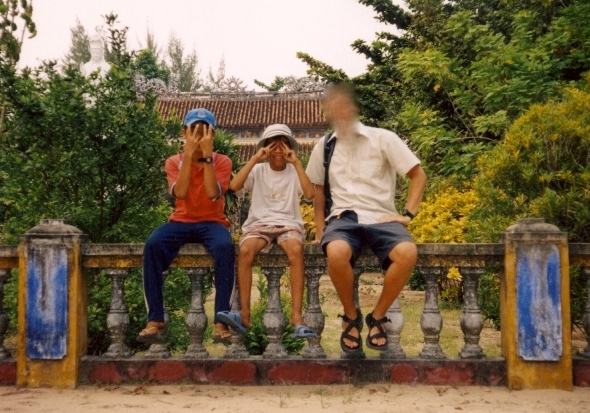
Throughout all of my adventures, only three times I’ve been a target for crime because I was a traveler. That’s not bad considering I’ve visited 40+ countries over the past two decades. For the most part, using common sense and traveling with a friend or group is enough to avoid travel scams and danger. But even the savviest backpackers will eventually meet their match.
Usually, it’s a harmless petty crime, like when two kids cleverly scammed me in Vietnam. Another time, a group of Andean street merchants in Ecuador colluded to try to steal my camera. Both were annoying, but not a big deal in hindsight.
More seriously though, I was robbed by a quartet of machete-wielding miscreants in Guatemala.
On my 14-month trip, I never carried anything expensive because I didn’t own anything expensive, and every penny to my name went toward extending the length of my trip.
But when a typical western tourist shows up in a third-world country with a wardrobe and camera worth three times a local annual wage, it’s no wonder they’re a target for petty crime.
Safety concerns and fear of thievery and travel scams is a deterrent for visiting even the most popular world destinations.
Maybe a little fear is a good thing to keep the hoards of people away from coolest sights!
Here are a few of stories about me getting scammed and robbed while traveling.
The ‘Buy Me Drink’ Scam
I had heard of dozens of travel scams around the world. But this one caught me by surprise.
Kids are one of the best parts of traveling. Their innocence and curiosity are infectious. Just about every encounter I’ve had with little kids while traveling, from playing billiards with young gypsies in Romania to countless roadside high-fives riding a motorbike in Cambodia, has been a delight. But sometimes there’s a dark side to kids and tourism.
In many tourist destinations, and especially in Hanoi and Ho Chi Min City when I was in Vietnam in 2002, kids were particularly aggressive. They would approach with a “badge” saying they are officially licensed to sell you overpriced packs of gum or jewelry.
They would put the product in your hand or on your wrist and then refuse to take it back! Of course, they want money in return instead of the pack of gum or bracelet. An adult mastermind is usually lurking nearby. These kids were relentless.
In smaller towns, annoyances like this were less frequent.
Outside the city of Hue, I waved hello to some little girls as I parked my motorbike to visit a historic site. When I returned, they left a big lotus flower on my seat. Then they disappeared into the bushes giggling.
Maybe that particular experience made me let my guard down, because in the next town, Hoi An, two enterprising little weasels got the better of me.
Evenings in Vietnam’s smaller towns are beautiful. The air temperature partially relents, while floating dust particles from the streets filter the last hours of light from the sun, giving the evening a dirty but exotic looking feel. The streets become vibrant with food, family, and culture. The rich aromas of supper mix with the pungent, yet strangely comforting odor of burning garbage.
During this time one evening, I set out to explore before meeting up with friends later on. As I was wondering around the town taking in the scenery, two kids approached me and said they wanted to show me a wat (Buddhist temple). Wats are fairly ubiquitous, but these kids made this one sound interesting. I followed. We exchanged names and shook hands.
At the wat, we crashed a wedding that was in progress. No one seemed to mind as most wats are open spaces, almost like public parks. We managed to get few giggles from the bridesmaids; maybe they thought I looked funny, or they knew the scam. The boys said they’d show me a few more wats if I bought them a drink afterward. Seemed like a fair deal. Most drinks were in the $.25 US range.
When the ‘tour’ was over, I agreed to treat them to a drink, thinking the three of us would sit down and chat. They wanted to take me to a particular refreshment stand. We walked past plenty of sufficient drink vendors, but they insisted we go to their favorite. I became suspicious.
Finally, we came to what looked like a residence. A few women sat outside with a small stand selling various snacks and drinks. I ordered a Coke and asked the boys what they wanted. Red Bull. WHAT! Red Bull was the most expensive drink by far, costing $2.50 US. As I was living on about $10 per day at the time, that was a quarter of my budget. But I relented, saying they could split it. We had a deal, and I didn’t put a restriction on the type of drink.
I sat down and cracked open my Coke. Then I waited. The younger boy sat there with the Red Bull can in his hand. He wouldn’t open it. That’s when it hit me. I encouraged him to open it. He looked away. I asked him again and he indicated he wasn’t thirsty.
So I stood up and left. It must have been his family’s stand. They likely pulled this scam a few times a day. They were good at it, and there were plenty of targets. I considered myself to be somewhat immune to scams before then, but I was only about 45 days into my long trip. Clearly, I had a lot to learn.
$2.50 doesn’t sound like much. But it was to me at the time, and it was worth a heck of a lot more to that family and the people in that town that likely lived on $1 or less per day. Had the boys drank the Red Bull, the experience would have cost the same but felt a lot more genuine. Instead, I felt like a sucker.
The ‘Ambush and Frisk’
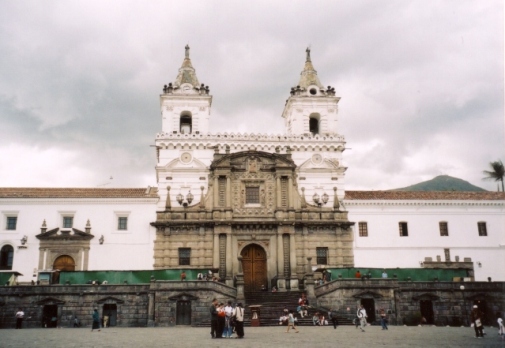
After four-and-a-half months in Asia, I went home for the holidays. Using frequent flyer travel rewards, I was able to book a free flight to Quito, Ecuador three weeks later.
The morning after I arrived, I went for a walk through a crowded market directly adjacent to San Francisco Plaza in the heart of the city. Knowing the risks of being in a crowded market, I looped my camera strap around my belt to secure it better in my pocket. This was an Olympus Stylus film camera; how times have changed.
As I progressed through the very crowded market, a clearing of bodies opened up, inviting me to walk through toward the market exit. Upon entering the lane, I was quickly closed in on and bumped around by four or five husky women wearing the traditional Andean dress and white aprons.
Getting stuck in a group of bodies wasn’t uncommon in a market like this. So I backed out the way I came in to find another route. The clearing opened again, so again I walked into it because there weren’t many other options. Again, they closed in on me. Something was up. My travel companion was diverted in another direction and I was stranded, getting bounced around by a pack of street merchants.
I could feel their hands start to frisk my shorts. So I instinctively pressed my hands on top of my pockets and looked for a way out. Then one woman spewed a large wad of spit on my forearm to try to distract me. It angered me instead, and I forcefully pushed my way out to the nearest clearing. My companion was confused, so I showed her the nasty hocker to help explain what happened. She fetched something to wipe it off with and we scurried away from the market.
I took an inventory of my pockets to see if anything was missing. I was wearing a money belt with my passport and valuables, so that was all intact. Some stray cash was still in my front pockets. To my astonishment, the perpetrators had seen the camera in my pocket and the strap loop and managed to cleanly cut the strap in the fracas, hoping to snatch it out. That’s what they were after. They had done this many times before.
I managed to escape with all my possessions, but the incident was a rude welcoming to a new continent.
The Old ‘Let’s Just Put A Machete To His Neck’
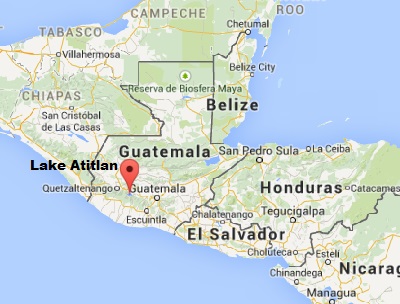
By far, the worst incident of the three was mostly my fault for not heeding prior warnings. I was staying in a tiny town called San Pedro La Laguna on Lake Atitlan in Guatemala.
This was one of the cheapest places that I’ve ever visited. I paid just $1.25 US for my own private room. Nothing fancy of course, but for that price, it was a great stop. This town is a classic backpacker enclave, complete with western style food, movie cafes and an old Canadian vagabond selling $4 ‘space cookies’.
Without much else to do, I embarked on a solo hike around the dirt roads of the lake through a number of small villages. I didn’t have a destination or plan, just my daypack and a little bit of cash. This was a common hike. However, a friend told me she knew a fellow backpacker that had recently been assaulted. A hostel message board displayed a similar warning. I figured I should leave my passport and valuables at the hostel, just in case.
After a good two hours of walking, I was on a dirt road banked by six-foot dirt walls and corn crops. I rounded a corner and headed down a slight grade. Then ahead of me I saw a young man drop off the dirt wall, turn up the slope and start walking directly toward me, making eye contact the entire way. He had a standard machete that is omnipresent in the Guatemalan countryside. Then another man popped out of the corn, and I heard something behind me. I turned around to see two more men jumping out of the maize, all carrying machetes.
The first man moved toward me fast and started shouting mochila mochila mochila! I was being robbed. The rest of the young men repeated the same thing, mochila mochila mochila! My Spanish wasn’t great, but I knew enough to understand they were saying bag or backpack, and I was carrying one. Since it was a day hike, I carried only a small bag with some snacks, the aforementioned short-strap camera, a little money, and a few other personal items.
Wrongly thinking there was a way out of the situation, I pretended I didn’t know what they were saying. It was pretty obvious though. The group became more aggressive and agitated. My delay tactics were promptly cut short as the clan leader, the first man I saw, pushed my shoulders down from behind and forced me to my knees. He crossed his left arm over my chest and then put the blade of his machete against my neck. Mochila mochila mochila!
Clearly, this had gone too far. When traveling for so long with so little, you tend to get attached to the few things in your possession. That day pack had been with me since Hanoi. The camera had some photos on it, and it was worth a lot to me. The bag also contained a small notebook I used to jot down notes and draw maps of various places I had been over the preceding ten months. The bottoms to my zip-off shorts were in that bag.
Soon enough, I came to my senses and determined the bag was more than a fair trade to keep my neck. So I let it go. The miscreants turned and ran, scattering into the maize, gone off to discover that the contents in the bag were mostly worthless aside from the camera, a little cash, and half a pair of pants.
Parting Thoughts about Travel Scams
If you’re wondering why you’re reading travel stories on a retirement blog, it’s because travel is what motivates me to retire. On top of that, many of my travel stories involve lessons about money, like the post about an ugly $1 bill in Myanmar and being a penny smart a pound foolish in Ireland.
Losing $2.50, or a $150 camera really sucked because those amounts were a bigger part of my net worth at the time. Reflecting on my travels also reminds me of frugal living and that the value of a dollar around the world is much greater than it is here. It keeps me grounded.
Even today when I track my dividends, $2.50 is important, because it’s money I earn passively, without any work involved. When I receive the dividend and reinvest it into another income producing stock, it compounds, slowly making me wealthier. If I do this with enough $2.50 dividends, eventually I’ll reach financial independence and what I consider the holy grail of travel.
Last month I received nearly $400 in dividends. That equates to about $13 per day. In Hoi An, I could probably live off that amount. If I don’t get hoodwinked by those kids again.
What about you? Have you ever been a victim of travel scams or robbed while traveling?

Craig is a former IT professional who left his 19-year career to be a full-time finance writer. A DIY investor since 1995, he started Retire Before Dad in 2013 as a creative outlet to share his investment portfolios. Craig studied Finance at Michigan State University and lives in Northern Virginia with his wife and three children. Read more.
Favorite tools and investment services (Sponsored):
Boldin — Spreadsheets are insufficient. Build financial confidence. (review)
ProjectionLab — Build financial plans you love. (review)
Empower — Free net worth and portfolio tracking + retirement planning. User since 2015.
Sure Dividend — Research dividend stocks with free downloads (review):
- Dividend Kings — 50+ stocks that have increased dividends for 50+ years.
- Monthly Dividend Stocks — List of 70+ stocks that pay a dividend every month.
- Dividend Champions — 140+ stocks that have increased dividends for 25+ years.