
10 Years In The Verizon DRIP
January 5th, 2014 marked the 10 year anniversary of buying my first share of Verizon Communications (VZ). Verizon became the third core holding in my portfolio after Chevron (CVX) and Coca-Cola (KO).
Those three stocks, along with Bank of America (BAC), I consider to be the four pillars of my investment portfolio that I intend to hold forever. BAC unfortunately was not as strong a pillar during the 2008-2009 financial crisis, but steps have been taken to solidify its core businesses to make it a stronger company going forward.
Approaching this Verizon DRIP milestone, I thought I would recap how my Verizon holdings got to this point, and I’ll share my tracking spreadsheet where I log all purchases and dividends.
Verizon Communications traces back to the 1984 breakup of AT&T (T). Bell Atlantic was created as one of the ‘Baby Bells’ as a result of the divestiture. Bell Atlantic remained the company name until 2000 when it merged with GTE and took on the name Verizon, a combination of the words veritas (latin for truth) and horizon.
In my opinion, the popularity of the band Vertical Horizon at the time likely had some influence on the name as well.
Why I Bought the Verizon DRIP in the First Place
I purchased my first mobile phone in 1999 through Sprint (S). The Sprint network was always frustrating because of dropped calls and bad service in my home. The network was so bad that I never considered giving up my land line while I was a customer, but still I kept Sprint until I left the country to travel in 2001.
When I returned from my 14 month trip to Asia and Latin America, I knew Sprint was not going to be my provider.
Verizon on the other hand had a good reputation for coverage so I signed up with them for my second mobile phone plan in 2002. The Verizon network made me a firm believer that investing in the network was of utmost importance in the competitive wireless phone market.
Upon looking at the stock as an investment, I saw a nice dividend yield and a reasonable valuation at the time. These two factors primarily influenced my decision to start a Dividend Reinvestment Plan (DRIP) to augment my portfolio.
The Purchases
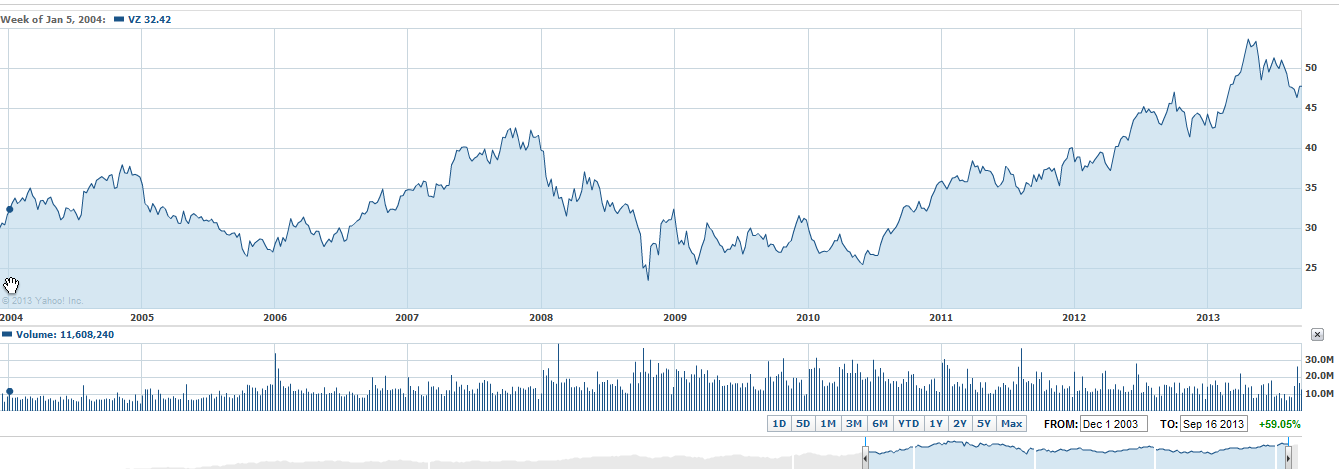
Between January 2004 and February 2011, I mostly purchased shares in $50-$100 increments on a monthly basis, except for brief pauses in 2005 and 2007. The price fluctuated between approximately $29 and $42 through that period. For as long as I have been investing in Verizon, I have reinvested all dividends. Investing at regular intervals and reinvesting dividends takes advantage of dollar cost averaging.
When the financial crisis metastasized in 2008-2009, Verizon’s stock was not severely impacted. The stock decreased, but customers didn’t stop paying their cell phone bills, and Verizon continued to invest in their FIOS wire line service and wireless network. The financial crisis provided a great opportunity to pick up more shares in the high 20’s and low 30’s. I continued to purchase shares in varying amounts on a monthly basis until February of 2011.
Since then, I’ve significantly cut back my new purchases, letting the shares I own appreciate and while reinvesting the dividends. All told, I have made $4950 in cash purchases of Verizon stock paying $39.95 in purchase fees since 2004.
The Dividends
Verizon has paid a dividend since it was formed after the AT&T breakup in 1984. While Verizon has consistently paid their dividend, it has not always increased the dividend on a yearly basis. This is particularly evident from 1997 through 2007 when it only increased the dividend one time.
Since 2007, however, Verizon has increased its dividend seven times, the last time being on November 6th of this year. These increases will hopefully continue. Verizon went through a number of complicated mergers and spin-offs during the non-dividend increasing period which perhaps explains why they were not increased. Verizon currently pays a $.53 dividend per quarter yielding about 4.4%.
Since I began investing in the Verizon DRIP in January 2004, I have received a total of $2034.35 worth of dividends, less $79.43 in dividend fees. That equals $1954.92 that I reinvested over the 10 year period. Also due to spinoffs, I received shares in Idearc (now SuperMedia) and Frontier Communications (FTR), both of which I sold immediately after receiving the shares (but did not reinvest).
The dividend increases for Verizon since 2007 have averaged 3.93%. This is not an impressive average, but better than nothing. The stock as of today (12/19/13) is trading above $48 and yields about 4.4%.
This gives me a yield on cash in of 8.13%. The value of my 189.881442 shares of Verizon at a price of $48.50 (as I write this) now equals about $9209. My current forward annual dividend income from Verizon is $402.55. The total return on my holdings is about 85% over the 10 year period.
I highlight the yield on cash in because this number shows the power of dividend increases and reinvesting dividends. Put another way, I have invested $4950 cash and $1954.92 of dividends into Verizon shares for an average purchase price of $26.07. The yield on that number with a 2.12 annual dividend is 2.12/26.07 = .0813 or 8.13%.
Every quarter I receive a dividend and reinvest it, my average purchase price goes down, and my yield on cash in goes up, as long as they don’t decrease the dividend and I don’t sell any shares.
This all happens passively, meaning I do nothing while my income grows.
Verizon Going Forward
Verizon recently purchased Vodaphone’s 45% stake in Verizon Wireless, putting Verizon on the path to significantly increase its cash flow. One concerning factor of this purchase is the issuance of a massive amount of debt, $61 billion, to finance the purchase.
However, with interest rates being as low as they are today, one could argue this was an ideal time to issue the debt and make this purchase. Shareholders and Wall Street analysts were highly supportive of this acquisition. Purchasing the Vodaphone stake also frees up cash flow to repay the debt and increase dividends over time.
Verizon is also expanding its FIOS service, albeit slower than it has in the past, and looking into other segments of business like purchasing Intel’s OnCue TV service as recently reported. Being in a consumer business, economic fluctuations could pose a risk to Verizon going forward. But today, voice and data is proving to be a staple consumer service, unlike cable TV which is facing dynamic shifts in the way consumers interact with viewing content.
Consumers’ voracious appetite for smart phones and data consumption is the norm going forward and will only grow from here. As far as I know, wireless and wire line are the only two ways to get data onto a device, and Verizon is a major player in both. If you know of another way to provide data to consumers that will displace wireless or wire line, please let me know!
This positions Verizon very strongly going forward. I plan to continue to build my position over time by purchasing shares when they are undervalued and reinvesting dividends, significantly contributing to my investment income portfolio and helping me reach my goal of retiring before my 56th birthday.
Disclosure: Long VZ, CVX, KO, BAC

Craig is a former IT professional who left his 19-year career to be a full-time finance writer. A DIY investor since 1995, he started Retire Before Dad in 2013 as a creative outlet to share his investment portfolios. Craig studied Finance at Michigan State University and lives in Northern Virginia with his wife and three children. Read more.
Favorite tools and investment services (Sponsored):
Alpha Picks — Data Driven Stock Picks from Seeking Alpha. Join now to save $50.
Boldin — Spreadsheets are insufficient. Build financial confidence. (review)
ProjectionLab — Build financial plans you love. (review)
Sure Dividend — Research dividend stocks with free downloads (review):
- Dividend Kings — 50+ stocks that have increased dividends for 50+ years.
- Monthly Dividend Stocks — List of 70+ stocks that pay a dividend every month.
- Dividend Champions — 140+ stocks that have increased dividends for 25+ years.