
Don’t Let an Oppressive Mortgage Prolong Your Career

A former manager was into office gift-giving.
Most of the team was over 50. As a joke, she gave everyone a pocket guide to texting acronyms.
The “older folks” were still learning about terms like LOL, TL;DR, LMFAO, OMG, and WTF.
This was around 2014 before we had our third child.
Flipping through the pages, I found a personal finance acronym I never heard of, SITCOM — single income, two children, oppressive mortgage.
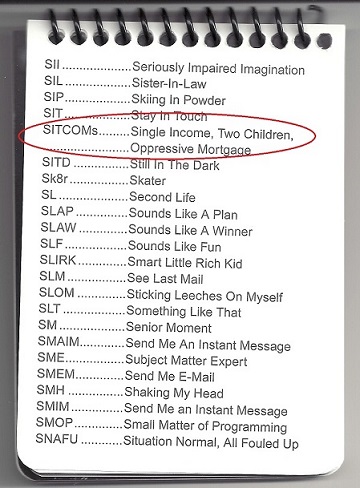
Ouch. That was us.
Our household became a single-income family in 2013. The mortgage wasn’t oppressive, per se, but I felt a significant weight on my shoulders when Mrs. RBD stopped working.
The weight prompted me to start this blog and build more income streams.
But it was nothing like 2006.
That year, I bought a 1BR condo. The very next day, I was suffocating.
I went from paying $750 in rent to a $2300+ housing payment overnight.
It took me more than a decade to clean up that mistake.
Taking on an oversized mortgage in your 20s or 30s is tough, but at least you have time to build your income and pay it off before retirement.
Upsizing a mortgage later in life runs the risk of prolonging a career.
Table of Contents
The Big Three
Maintaining control of the big three expenses is key to early retirement. They are:
- Housing
- Transportation
- Health Insurance
Where you live and what you spend on housing impact your savings rate (monthly income minus expenses).
The savings rate is a key number for early retirees. The higher your savings rate (as a percentage of take-home pay), the sooner you can retire.
Therefore, those few stages in life when we buy a home carry significant long-term consequences.
If the mortgage payment takes up a large percentage of take-home pay, there’s less to spend on life’s necessities, reducing savings and prolonging your career.
Car payments do the same thing.
Owning a car without debt or not driving are simple ways to get ahead.
Health insurance is necessary. But there are a range of pricing options, especially if still employed.
If you buy, let’s say, two homes and ten cars throughout your life, that’s 12 critically important life moments where you can choose to give yourself a financial advantage.
Car buying mistakes are fixable. Housing purchase mistakes are harder to reverse.
Too often, some of us learn how significant the home purchase decision was after closing.
Real estate agents and mortgage brokers won’t encourage you to spend less. They’re paid more when you exceed the budget.
That leaves you and a mortgage spreadsheet as the only barriers to overspending on the house.
First-Time Buyer Housing Affordability Rules
There are a few housing affordability rules of thumb out there.
Dave Ramsey says that your payment should be no more than 25% of your family take-home pay using a 15-year fixed mortgage.
That’s quite conservative and can be unrealistic in some urban areas.
Mortgage lenders use something called the 28/36 rule. It says to have a mortgage payment (including escrow, taxes, insurance, etc.) of no more than 28% of gross monthly income and spend no more than 36% on total debts.
43% total debt is another important threshold I found. That’s too high.
Here are some reasonable guidelines for first-time homebuyers (let’s say, under 40-years-old):
- No high-interest debt — If you have credit card debt, pay that off before buying a home.
- Aim to save 20% for a down payment — Prove you’re a worthy borrower and avoid higher interest rates and private mortgage insurance.
- Mortgage payment (all-inclusive) no more than 33% of take-home pay (after 401(k)/403(b) contributions) using a 30-year mortgage.
The best rule of thumb for you depends. You may value a nicer home or premium location over early retirement.
These guidelines may not get you into your dream home upon your first purchase. I get that.
It may be difficult to buy the home you want when you want it. But being more conservative with your first purchase might open opportunities.
- The first home could be a stepping stone, introducing you to homeownership, helping to envision your ideal home.
- The lower payment allows you to increase your savings rate, bumping up your retirement date.
- The lower payment lets you save for your ideal home.
- The first home could eventually become a rental when you move.
You may get comfortable in your less expensive house. If you like it there, that’s a financial win. If it’s not right, there are reasonable options.
Mid-Career Housing Upgrades
It seems common that some families or couples upgrade their home when one earner gets a big promotion or raise.
One of our former neighbors moved a mile away to a “more uppity neighborhood,” as the woman on the Nextdoor social media platform called it.
They came back for a block party and said the new street didn’t have the same community feel.
I want to think that their new household income enabled them to afford the more prominent, contemporary home with ease.
But I wonder — did spending twice as much on a different house tack time onto their working years?
I’ll never know their financial situation.
But it makes me more aware of the risk that housing can become an obstacle to financial freedom.
Our Housing Story
When Mrs. RBD moved into my 1 BR condo, the savings helped her to pay off her car and student loans within a few months.
Soon after, our combined incomes empowered up to save a 20% down payment for a house in the suburbs.
We hurried to buy.
Pre-SITCOM, HGTV got the best of us.
We could have waited and saved more or bought a smaller starter home and upgraded a few years later, in hindsight. But here we are.
Our house has its annoyances.
- The backyard is sloped, and there are drainage issues.
- We don’t have a garage or shed, so we keep yard tools and bikes in our basement.
- The previous owner painted our unfinished basement and laundry room lavender (too much square footage to bother repainting).
- We have a narrow galley kitchen; the freezer door causes traffic jams when open.
- The bathrooms have no windows.
By no means is it the dream house of my childhood.
But by and large, the RBD household is almost perfectly suited for our family.
We have five people, and there are five bedrooms, four of which are on the same floor.
Each of our kids has a room, and we’re nearby when the boogie monster visits.
The fifth bedroom is my office and accommodates a blowup mattress for guests.
The neighborhood is full of kids the same ages as ours.
A five-bedroom house may sound big, but it’s an unflashy 1960’s split-level. It’s kind of shaped like the Brady Bunch house, but no fabulous architectural interior.
Though well-suited for us now, it’s probably not a forever home.
Our ideal home may not be bigger, but it would be smarter — a modern layout, a flatter backyard, more privacy, and a garage.
Some annoyances can be fixed or upgraded. But others, like the backyard and garage, cannot without significant expense.
Our ideal house (in the same area) would probably cost $150,000 to $200,000 more than our current home value. Meaning we either need to save up the cash or take on a larger mortgage.
I’m 45-years-old. My goal is to retire within ten years.
Adding $200,000 to our mortgage balance is out of the question.
I don’t want an oppressive mortgage to prolong my career.
The Mortgage Dilemma
My preference is to live in a paid-off house when I retire. That would require aggressive extra mortgage payments starting today to be mortgage-free by age 55.
We refinanced to a 20-year 2.75% mortgage in September 2020, which takes me to age 65.
With such a low rate, aggressive early payments don’t make a lot of sense — though paying it down would be a 2.75% risk-free return, much better than bonds and high yield savings accounts.
I’ve struggled with this topic for many years, so you may see conflicting thoughts if you explore my archives.
I’m 100% OK with paying off a mortgage early, regardless of the interest rate and mathematical arguments.
If you regret it paying off debt, you can always reborrow.
However, rates may be higher in five years (a familiar refrain for the past decade, so take it with a grain of salt).
Most people who are mortgage-free don’t seem to regret it.
On the other hand, if I invest or save excess cash flow instead of paying down the mortgage, that gives me capital growth, investment income, and flexibility.
Extra cash on hand could provide the flexibility to leave my career sooner. Or I could save up the month and pay off the mortgage in a lump sum.
More likely, I’ll maintain a healthy opportunity fund and invest most excess cash flow into income-producing assets.
Reality is setting in — I may carry a mortgage into retirement, whether we buy a different house or stay here.
I don’t want the mortgage to be a deterrent to retirement. If it remains small, we’ll have enough savings and investment income to cover the payment.
Options to Avoid a Career-Extending Housing Mistake
Yes, we would like a more expensive house.
But no, I’m not willing to prolong my career to have it.
So what options remain?
Stay and Do Nothing
We’ll likely stay in this home until the kids are out of elementary school. There are so many kids here that it’s an ideal environment for our children. Once they’re all in junior high, we may start looking for a different home as our needs change.
Stay and Remodel
My wife has an eagle eye for kitchen remodels. That would cost a lot, but it’s cheaper than moving. Our cabinets can be rearranged, saving us that considerable expense. But walls would fall.
We could build a garage, but we’re planning to install a large shed to store our bikes and yard tools. That will create more space to finish our basement.
Earn More and Move
I could get a big raise, making it easier to afford a different home. But it would have to be major. And moving after a big raise would make me more reliant on my full-time job.
I made this mistake back in 2006. I bought my first property after receiving a $22,000 raise, thinking that made me a qualified homebuyer. It didn’t.
Instead, I went from being a young single guy thriving in an inexpensive group house to being one paycheck away from financial trouble.
The more desirable outcome now would be to grow my side business to give us more financial flexibility.
Increase Passive Income
Building more passive income streams would help, but it’s unlikely that stock dividends will grow enough to warrant upgrading to a different home. Nice thought, though. I’d probably sell assets before increasing them to be sufficient to cover the mortgage.
Build Cash Savings and Move
The most likely outcome is we save the extra $200,000 to move to a different home sometime in the next decade.
Then sell this home and transfer the equity, thereby buying the home with an equal or less mortgage balance and a ten or 15-year mortgage.
This scenario would require scaling back on investing and building a cash stockpile. It’s doable, but it would take a significant commitment.
Since we’re comfortable where we are, I’m not ready to make that change in our financial habits until we’re more certain of what we want.
Rent
We could sell the house and rent something else. Or rent our house, then find a rental to live in.
Always an option, but unlikely for us at this time.
Bonus Idea – Pretend You Already have a Higher Mortgage
I friend of mine texted after reading this article. Here’s what he’s doing:
I lately adopted a strategy whereby I make monthly mortgage payments based on the hypothetical more expensive house I want to buy in 3-5 years. I’ll build up equity AND make the higher payment seem routine and within budget (and prove to myself I can afford it). In my mind, I’m already paying for a higher mortgage and won’t feel the pain when it happens!
Conclusion
Reading this post is like sitting in my living room, listening to the same conversation I’ve had with Mrs. RBD dozens of times over the past eight years.
The thought of moving to a different home is appealing on the surface. A different home would eliminate some annoyances but create new ones. And it probably wouldn’t increase our happiness over the long-term.
Leaving this neighborhood seems unwise while the kids are young. It’s unlikely we’d be so lucky if we moved.
So if and when the time is right, we’ll execute a plan to purchase a different home without an oppressive mortgage or sacrificing my retirement goal.
That seems reasonable. But five years from now, I may end up republishing these same words, only changing a few numbers.
Photo via Pixabay

Craig is a former IT professional who left his 19-year career to be a full-time finance writer. A DIY investor since 1995, he started Retire Before Dad in 2013 as a creative outlet to share his investment portfolios. Craig studied Finance at Michigan State University and lives in Northern Virginia with his wife and three children. Read more.
Favorite tools and investment services (Sponsored):
Alpha Picks — Data Driven Stock Picks from Seeking Alpha. Join now to save $50.
Boldin — Spreadsheets are insufficient. Build financial confidence. (review)
ProjectionLab — Build financial plans you love. (review)
Sure Dividend — Research dividend stocks with free downloads (review):
- Dividend Kings — 50+ stocks that have increased dividends for 50+ years.
- Monthly Dividend Stocks — List of 70+ stocks that pay a dividend every month.
- Dividend Champions — 140+ stocks that have increased dividends for 25+ years.